



Blog
Rupee Hits ₹95.31 Against US Dollar: How India’s Currency More Than Doubled in 22 Years and Why It Matters

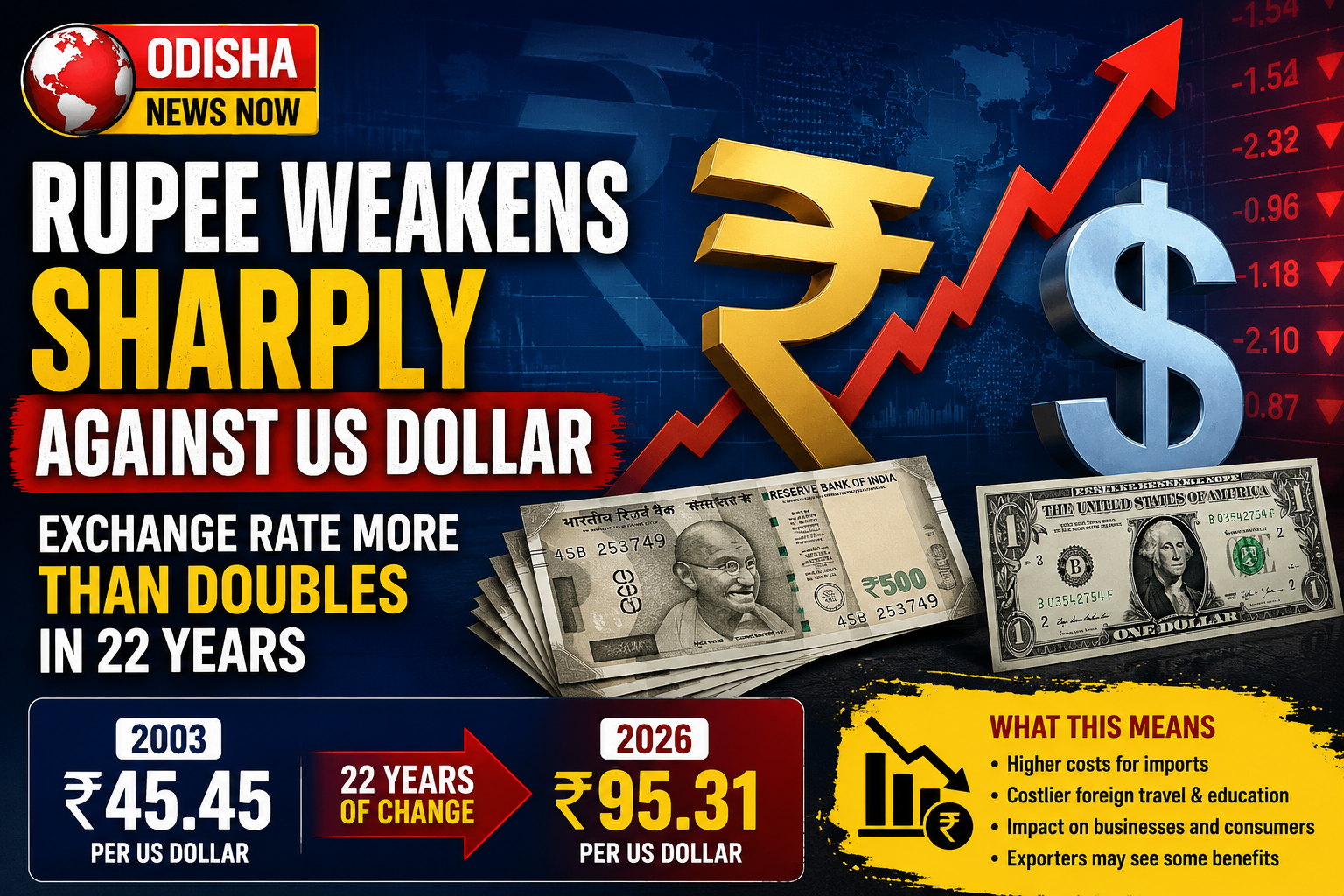
Bhubaneswar, July 3: The Indian rupee has weakened significantly against the US dollar over the past 22 years, with the exchange rate rising from ₹45.45 per US dollar in December 2003 to around ₹95.31 on July 3, 2026.
According to exchange-rate data, one US dollar was trading at approximately ₹95.3155 on Thursday, highlighting the long-term depreciation of the Indian currency.
The figures show that the rupee cost of buying one US dollar has more than doubled since 2003, reflecting a major shift in India’s currency landscape.
Rupee’s 22-Year Journey
In December 2003, one US dollar cost around ₹45.45.
Over the next two decades, the rupee witnessed several phases of appreciation and depreciation, influenced by domestic economic conditions and global financial events.
For a brief period, the exchange rate even fell below ₹40 as the rupee strengthened. However, the trend reversed following the global financial crisis, with the dollar gradually becoming more expensive.
The USD-INR exchange rate later crossed the ₹50, ₹60, ₹70 and ₹80 marks before reaching around ₹95 in July 2026.
Despite periodic recoveries, the broader long-term trend has remained upward.
What a Weaker Rupee Means
A weaker rupee means more Indian currency is required to purchase the same amount of US dollars.
For instance:
- In December 2003: Buying US$1,000 required approximately ₹45,450.
- In July 2026: The same amount now costs about ₹95,310, excluding bank charges and conversion fees.
The change directly affects international travel, overseas education, imports and foreign payments.
Why Has the Rupee Weakened?
Economists say currency movements are influenced by multiple domestic and global factors rather than a single event.
Some of the key reasons include:
- Strength of the US dollar in global markets.
- Rising crude oil prices, as India imports most of its petroleum requirements.
- Inflation differentials between countries.
- Interest rate decisions by central banks.
- Foreign investment inflows and outflows.
- India’s trade deficit and demand for foreign currency.
- Global geopolitical tensions and economic uncertainty.
These factors together determine the demand and supply of the rupee and the US dollar in international currency markets.
Impact on Consumers
The depreciation of the rupee can have a direct impact on households and businesses.
Imported products such as electronic goods, machinery and industrial components may become costlier as importers need more rupees to buy dollars.
Foreign travel also becomes more expensive, while students studying abroad may face higher tuition fees, accommodation costs and other expenses after currency conversion.
Businesses dependent on imported raw materials could also see higher operating costs, some of which may eventually be passed on to consumers.
Exporters May Benefit
A weaker rupee is not entirely negative.
Indian exporters earning revenue in US dollars often receive higher returns when those earnings are converted into rupees.
Industries such as information technology, pharmaceuticals, textiles and engineering exports may benefit from favourable currency conversion.
However, experts note that the actual gains depend on import costs, foreign currency borrowings and hedging strategies adopted by individual companies.
What Lies Ahead?
The future direction of the rupee will depend on several evolving factors, including India’s economic growth, inflation, crude oil prices, US monetary policy, foreign investment flows and global geopolitical developments.
Currency markets remain highly dynamic, making both appreciation and further depreciation possible in the coming months.
For consumers, businesses, students and investors alike, the rupee-dollar exchange rate will continue to be one of India’s most closely watched economic indicators.
- Trending
- Guru Purnima 2026: In The Age Of AI, Do We Need Gurus More Than Ever?

- Niladri Bijay 2026: Why Lord Jagannath Must Offer Rasagola Before Returning Home

- Adhara Pana 2026: Why A Sacred Drink Is Offered To Lord Jagannath And Then Deliberately Spilled

- Suna Besha 2026: The One Day Lord Jagannath Appears Adorned In Gold

- Odisha Police Arrest 9th Member of Inter-State Ganja Syndicate; Assets Worth Nearly ₹4 Crore Frozen