


Blog
2 Years Of Mohan Majhi Government: What Changed In Odisha And What Didn’t?

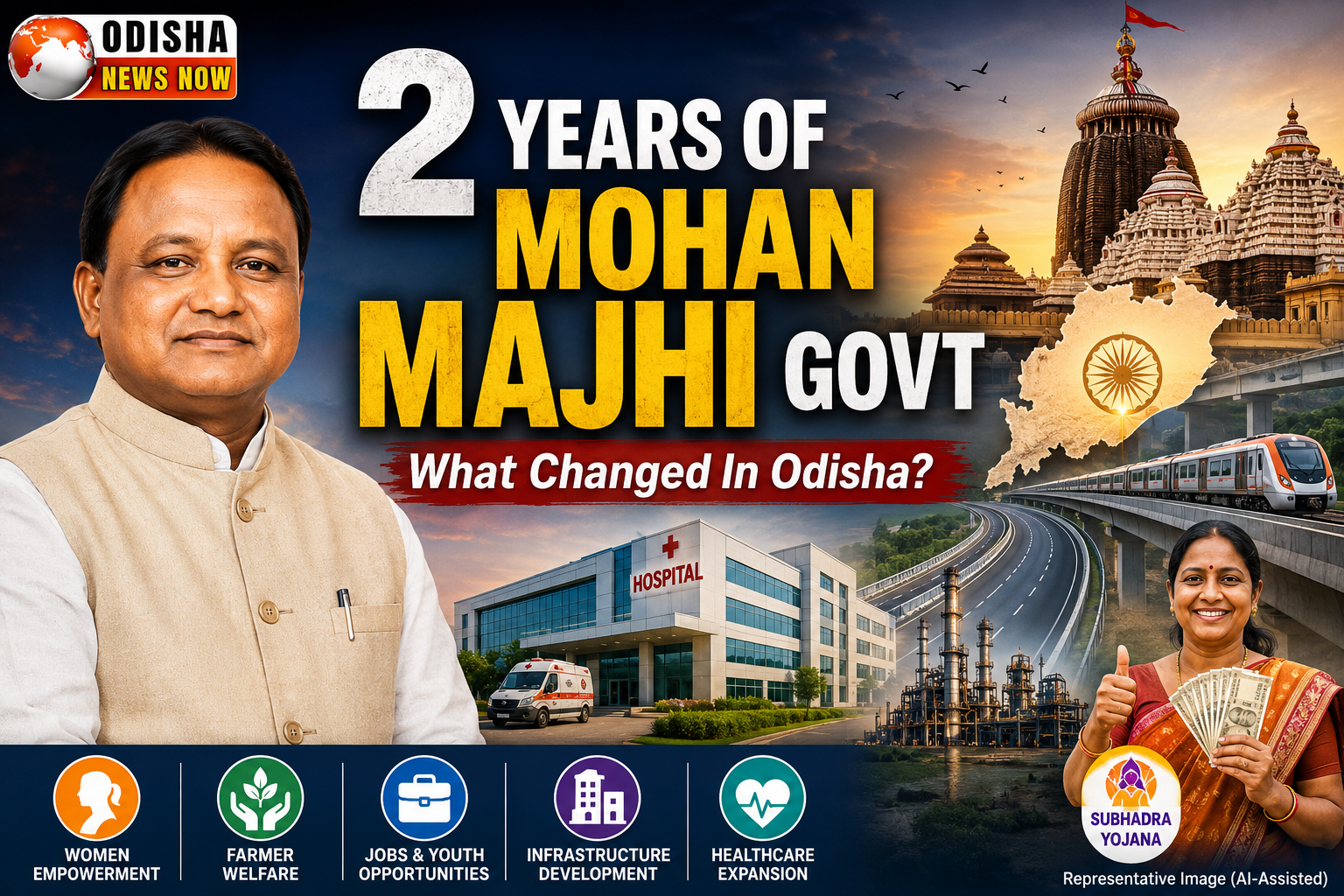
Bhubaneswar: On June 12, 2024, Odisha witnessed a political shift many believed was impossible. The Bharatiya Janata Party ended Naveen Patnaik’s uninterrupted 24-year rule and formed its first government in the state under Chief Minister Mohan Charan Majhi. Two years later, the question is no longer whether the BJP could win Odisha. The question is whether it has governed differently enough to justify the historic mandate it received.
The answer depends on where one looks.
In two years, the Majhi government has rolled out flagship welfare schemes, expanded healthcare coverage, pushed industrial investments, accelerated infrastructure projects, and attempted to build a political narrative around “Odia Asmita”. At the same time, questions remain over employment generation, law and order, delivery of promises, and whether the BJP has fundamentally altered the administrative culture it had criticized while in opposition.
The Biggest Political Change: Odisha Is No Longer A One-Party State
For nearly a quarter-century, Odisha politics revolved around one leader—Naveen Patnaik. The BJP’s victory in 2024 did more than change the government; it transformed the state’s political landscape.
Two years later, Mohan Majhi has emerged from being viewed as a surprise choice for chief minister to becoming a politically stronger leader within both the state and the party. Observers note that he has consolidated authority within the government and increased his visibility across Odisha.
The BJP’s larger achievement may not be any individual scheme but the normalization of political competition in a state long dominated by a single regional party.
Welfare Politics: The Rise Of Subhadra And Direct Benefit Governance
One of the government’s biggest priorities has been women-centric welfare.
The BJP entered office promising targeted support for women, farmers, youth and economically weaker families. Over the last two years, welfare delivery has become central to the administration’s political messaging, with schemes such as Subhadra emerging as flagship initiatives aimed at women beneficiaries. Women’s empowerment programmes have remained a recurring focus of government outreach.
For many beneficiaries, the BJP government is increasingly being judged not by ideology but by whether money reaches bank accounts, services improve, and benefits are delivered on time.
Healthcare: A Visible Shift After Years Of Political Debate
Healthcare is one area where the government can point to tangible expansion.
The implementation of national healthcare initiatives and the inauguration of major medical infrastructure projects have been among the administration’s most visible achievements. Recently, the government unveiled a 650-bed teaching hospital at Pandit Raghunath Murmu Medical College in Baripada as part of development projects worth over ₹430 crore in Mayurbhanj.
Supporters argue that integration with central healthcare programmes has expanded options for patients, while critics contend that improvements in rural healthcare delivery and doctor availability remain uneven.
Industry And Investment: Big Announcements, Bigger Expectations
No sector better illustrates the promise-versus-performance debate than industry.
The Majhi government has aggressively promoted Odisha as an investment destination. In April, the government launched 36 industrial projects worth more than ₹40,000 crore, claiming potential employment generation of nearly 59,000 jobs. Officials have also highlighted foundations and inaugurations linked to projects worth approximately ₹2.5 lakh crore and associated employment commitments.
The challenge, however, is that investment announcements and actual jobs are not the same thing.
The political test for the BJP will be whether employment opportunities become visible on the ground over the next few years, particularly for educated youth who remain one of the state’s most impatient voter groups.
Infrastructure: Faster Execution, But Delivery Remains Key
Roads, healthcare institutions, administrative facilities, and district-level projects have seen increased attention under the current government.
The administration has repeatedly emphasized infrastructure as one of the four pillars of its governance model alongside welfare, employment and cultural identity. Multiple district-level development projects have been inaugurated over the last two years, reflecting an attempt to distribute development beyond Bhubaneswar and Cuttack.
Yet infrastructure projects are often judged years after announcements. The real verdict will depend on completion rates, quality and long-term public utility.
Odia Asmita: Symbolism Or Strategic Politics?
Perhaps the most distinctive feature of the BJP government has been its emphasis on “Odia Asmita” (Odia identity).
From cultural initiatives to political messaging, the government has sought to position itself as a protector of Odisha’s heritage, language, traditions and religious institutions. The theme has become a recurring element of the administration’s public narrative and remains central to the BJP’s attempt to build a long-term emotional connection with voters.
Supporters see this as a restoration of cultural pride. Critics argue that symbolism alone cannot substitute for governance outcomes.
Where The Government Faces Tough Questions
Not all indicators are positive.
Opposition parties continue to question the pace of implementation of key promises. Law and order has emerged as a recurring concern, with criticism focusing on violent crimes reported across multiple districts. Questions have also been raised regarding the government’s handling of corruption allegations and whether promised accountability measures have been pursued aggressively enough.
The BJP’s challenge is that expectations remain exceptionally high because it came to power promising change rather than continuity.
The Employment Question Remains Unanswered
If there is one issue that could define the next phase of the Majhi government, it is employment.
The administration points to investment commitments, recruitment drives and industrial expansion. Critics counter that many young Odias are still waiting to see meaningful job creation at scale.
The gap between announced opportunities and actual employment outcomes may ultimately become the most important metric by which voters judge this government.
The Verdict After Two Years
Two years into office, the Mohan Majhi government can legitimately claim that it has altered Odisha’s political direction and introduced a new governance narrative centered on welfare, infrastructure, industry and Odia identity.
What it cannot yet claim is a final verdict.
The government has strengthened its political position, expanded its welfare footprint and accelerated investment outreach. But voters are now moving beyond promises and announcements. They are asking harder questions: Are jobs increasing? Is governance improving? Has corruption reduced? Are public services better?
The first two years were about transition.
The next three years will be about delivery.
And that is where the real political test of the Mohan Majhi government begins.
- Trending
- Guru Purnima 2026: In The Age Of AI, Do We Need Gurus More Than Ever?

- Niladri Bijay 2026: Why Lord Jagannath Must Offer Rasagola Before Returning Home

- Adhara Pana 2026: Why A Sacred Drink Is Offered To Lord Jagannath And Then Deliberately Spilled

- Suna Besha 2026: The One Day Lord Jagannath Appears Adorned In Gold

- Odisha Police Arrest 9th Member of Inter-State Ganja Syndicate; Assets Worth Nearly ₹4 Crore Frozen